

In honor of the anniversary of parishioners successfully saving St. Francis from destruction, Rebekah Coffman, Curator of Religion and Community History, and Elena Gonzales, Curator of Civic Engagement & Social Justice, tell the history drawing from CHM collections such as the Chicago building clearance photographs, 1939–58, and the documentary film No Abandonarémos a San Francisco de Asís, interviews with parishioners, and local scholarship.
In Chicago, Catholic parishes form a kind of visual marker and place maker for Latinidad, though their architecture may not always speak to this heritage at first. The geography of Chicago has been deeply influenced by Catholic parishes, with wave after wave of immigrants finding spiritual and communal refuge within church walls as the Archdiocese of Chicago defined parish boundaries and established church buildings based on ethnic identities and spoken languages. Many churches that initially served European congregations are today majority Latine in attendance. Most hold Spanish language services in addition to masses in English, Polish, and other European languages. These social layers of use by different communities through time serve as windows into the world of Latine migration to and presence within the city.
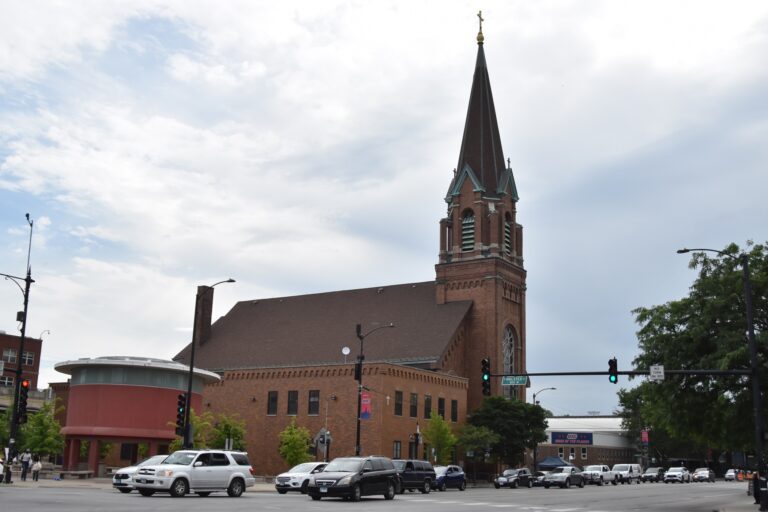
Exterior of St. Francis of Assisi Catholic Church, 813 West Roosevelt Road, Chicago, 2024. Photograph by Jojo Galván Mora
On the Near West Side, St. Francis of Assisi Catholic Church stands as a testament to how people make change through coordinated resistance. Originally founded as a German Catholic church in 1853, it became known as la catedral mexicana as the neighborhood’s Mexican community grew through the 1920s and into the 1950s, with a separate Spanish-language service starting in 1925.
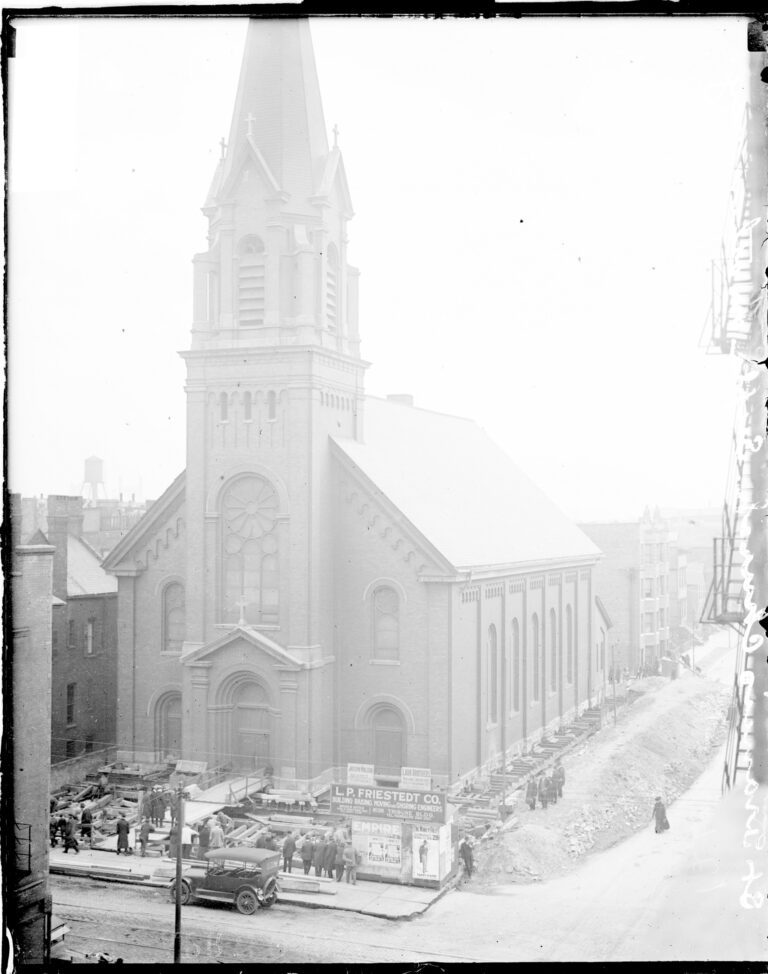
Exterior view of St. Francis of Assisi Catholic Church, Chicago, 1917. DN-0067872, Chicago Daily News negatives collection, CHM
At its peak, 5,000 parishioners attended each Sunday. In 1961, the neighborhood was decimated by vast building clearances in preparation for the University of Illinois Chicago campus. St. Francis remains an important hub for weekend services, but the neighborhood was forever changed.
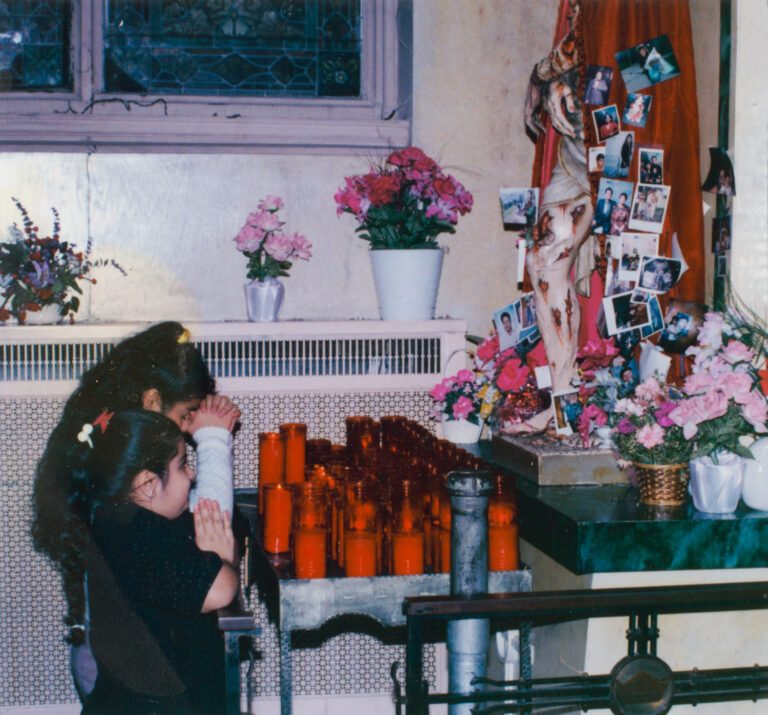
Two girls praying at an altar after lighting candles for St. Francis at St. Francis of Assisi Catholic Church, Chicago, c. 1993. CHM, ICHi-183466; Gregg Mann, photographer
Despite strong attendance, the Catholic archdiocese proposed closing St. Francis in late 1993, with a public announcement in January 1994. Congregation members immediately began organizing in opposition, forming the St. Francis of Assisi Preservation Committee. They protested in front of the cardinal’s mansion and signed petitions, gaining media attention.
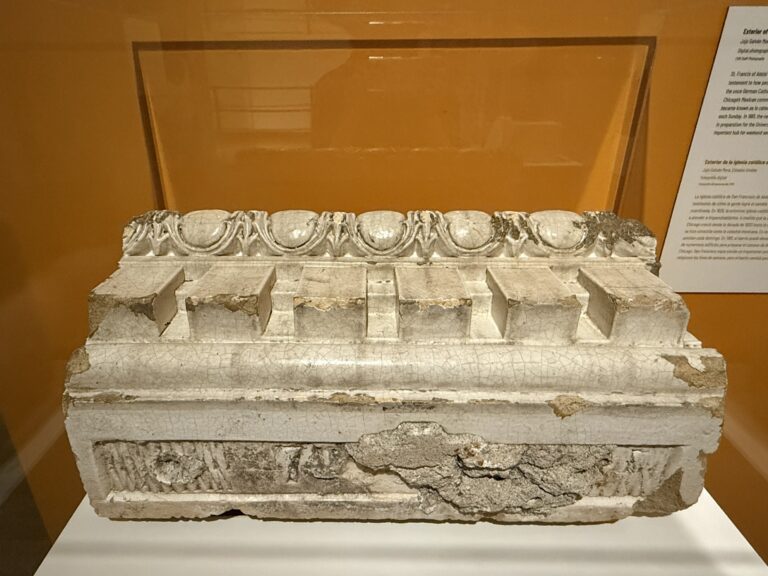
This architectural fragment of glazed terra-cotta (c. 1918) shown in Aquí en Chicago was salvaged from the renovation of the rectory and is a reminder of this important fight to remain. Courtesy of Margarita and Carlos Villaseñor
The doors to St. Francis were officially closed November 1994, and workers began dismantling the church’s fixtures and decorative elements. Protests and vigils continued through 1995, and later that year the iconic stained-glass windows were removed and eventually repurposed at St. Paul Chong Hasang Korean congregation in Des Plaines, Illinois.
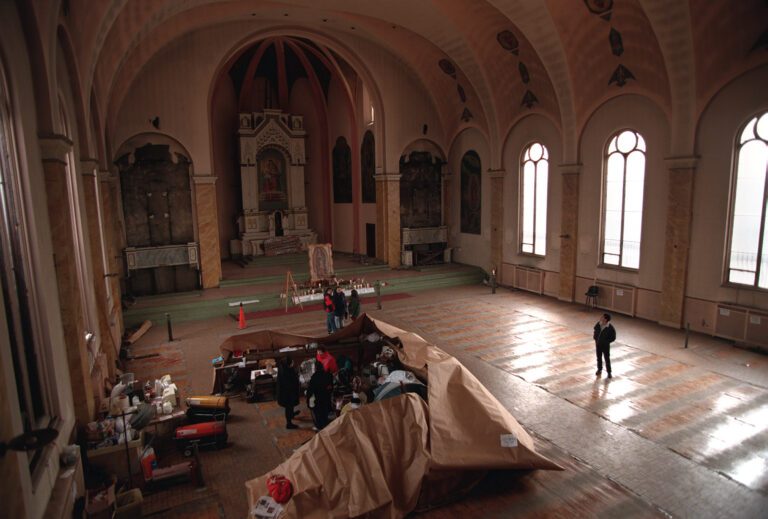
St. Francis of Assisi parishioners occupy the church, February 6, 1996. Note the empty window frames. STM-000011223, Chicago Sun-Times photograph collection, CHM
On January 29, 1996, structural demolition work began. The preservation committee went into action, calling news media and local government officials. As a final resort, parishioners, including Carlos and Margarita Villaseñor, began occupying the church on Sunday, February 4, 1996, in a frigid cold snap with the wrecking ball parked outside. The church was unheated, and parishioners made makeshift tents and placed cardboard over open doorways to keep warm. They stayed until the following Tuesday, when the archdiocese’s Bishop John Manz hand-delivered a letter declaring the church would not be torn down and demolition equipment was removed. St. Francis was officially reopened on April 6, 1996, and remains a sacred refugio today. The replacement stained-glass windows document this history and the parishioner’s fight to save their church.