
That program, backed by grass-roots organizing and sophisticated political leadership, has touched voters and made the left far more viable in local elections.
The political muscle of Los Angeles’ rising liberal faction is demonstrated not just in the number of candidates who identify with the Democratic Socialists, but more broadly in the way it helps shape the policies and priorities of the city generally.
It was not long ago that support for increased LAPD spending was a unifying city objective. Conservatives favored the idea of stricter enforcement of the law, while liberals saw it as a way to pay for police reform and to empower its oversight. No more.
Although “defund the police” is a bygone slogan, the LAPD’s critics are plentiful and are unwilling to acquiesce to once-routine budget requests to maintain or expand police ranks. The department today employs about 8,500 officers, well below peak staffing levels and far below the long-sought goal of 10,000. Nevertheless, Mayor Karen Bass’s recent request for additional funding ran into opposition at the City Council.
The council ultimately approved a cut-down version of the mayor’s request, but the compromise will barely allow the LAPD to hold its own against retirements and other attrition. Four council members – Hernandez, Soto-Martinez, Raman and Councilmember Ysabel Jurado – opposed even that.
Taxing the rich
Some of those same forces are at work in the debate over a “mansion tax,” a favorite idea of the LA left. The tax, which voters approved in 2022, applies to multimillion dollar real estate transactions, adding a 4% levy to sales over $5.1 million and 5% to properties over $10.3 million (the thresholds are indexed, hence the unusual threshold numbers). The tax revenue goes for construction of affordable housing.
Taxing the rich is always good populist politics, but here it helped frame the city’s changing politics. Bass, for instance, sought to exempt properties affected by the Palisades fire, as she worked to balance her support for affordable housing with her commitment to rebuilding from the fire.
The result has been more confusion than clarity, a testament to the challenges of managing a shifting electorate — especially in an election year.
The fight over the tax goes on, but its very persistence says something about the city’s leftward drift. It’s inconceivable that Mayor Riordan, for instance, would have supported the mansion tax and hard to imagine voters 20 years ago approving it. Riordan lived in Brentwood in a home that would have qualified for the surcharge, and the emphasis of much of the city’s politics in those days was on safety and job creation, rather than equity or government-backed affordable housing.
There are many reasons for the leftward shift, and not all of them are specific to Los Angeles. The nation’s economic inequality continues to expand, and the plight of those left out of economic growth grows increasingly dire and visible in big cities, where opulence and poverty live side by side.
That’s inescapable in modern Los Angeles, with its grand homes, flashy boutiques and grinding homelessness.
Trump and the election year
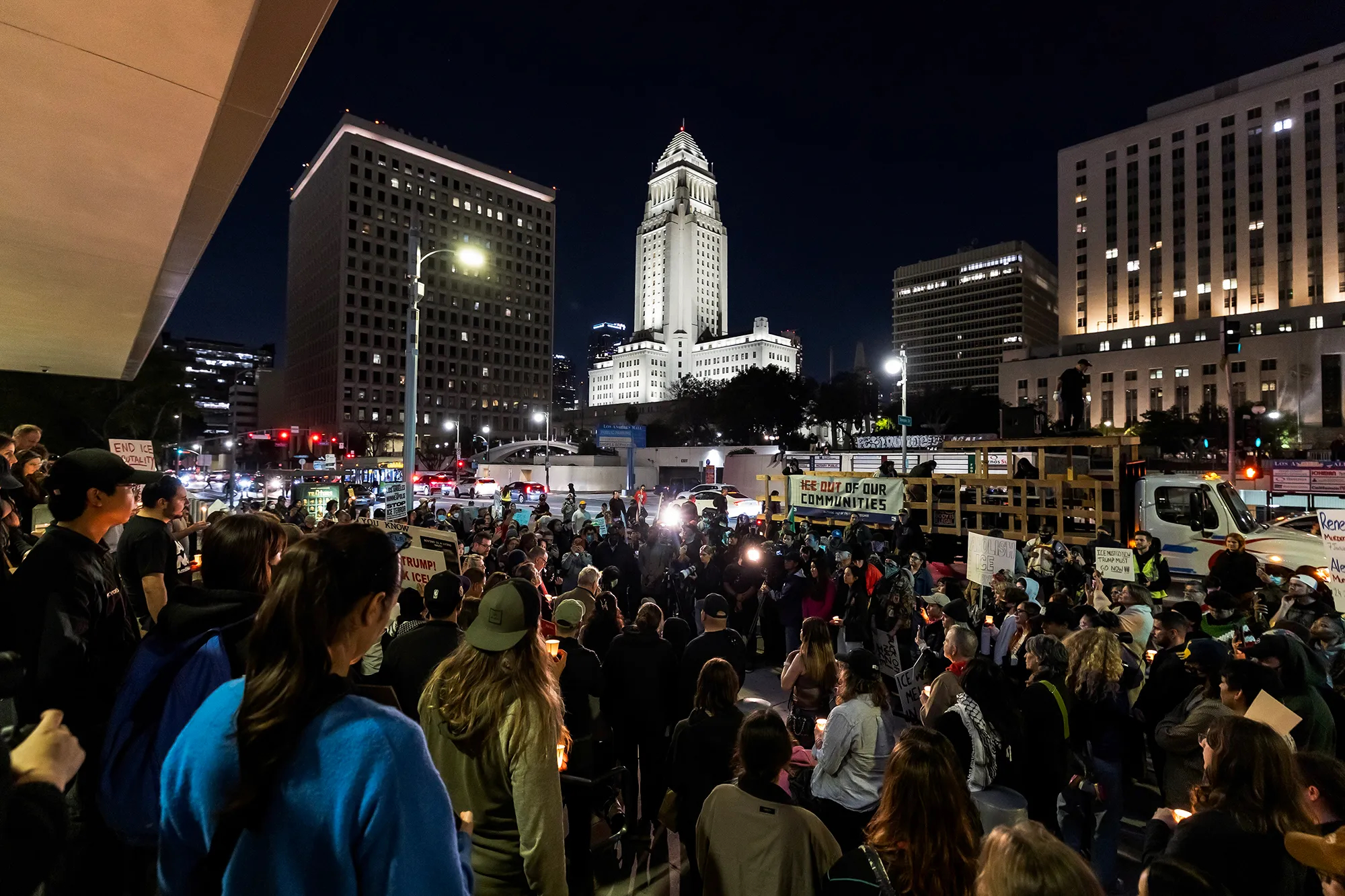
The local left also has clearly thrived in the era of President Donald Trump. The president, who is fond of denigrating Los Angeles and California, is reviled in Los Angeles. His influence has radicalized liberals, making them willing to vote for new Congressional maps — Los Angeles County favored last year’s Prop. 50 by a staggering 74% to 25% — and rise to the defense of undocumented migrants.
More purely political changes have contributed as well. Los Angeles in 2015 switched its election schedule from voting in odd-numbered years to coinciding with the gubernatorial and presidential election cycles.
That’s been a change with mixed results, but one clear consequence has been to broaden the participants in city elections. An electorate once dominated by homeowners and wealthier interests now increasingly includes lower-income voters and renters, whose interests tend to pull the city toward programs such as rent control and away from priorities such as forceful police protection.
And so 2026 is a notable election year for Los Angeles.
One marker of the cycle spinning up came this week, as Mayor Bass held the first of two State of the City addresses to present her view of where the city stands at this moment.
The gathering was illustrative in many ways: Held near the Los Angeles Memorial Coliseum in one of the city’s most Black and Brown communities, it anchored Bass among some of her most loyal supporters. The location also highlighted Los Angeles’ role as host of the World Cup and, in 2028, the Summer Olympics. In a gesture toward civic unity, Bass’ presentation even featured performances by the marching bands of UCLA and USC.
The State of the City
The audience’s response to Bass’ remarks also said something. She was politely applauded when she highlighted the city’s historic progress against crime: Los Angeles had 230 homicides last year, the lowest number since the 1960s and a startling change from the 1990s, when it tallied more than 1,000 homicides several years in a row.