

The other federal organization, America250, is a nonpartisan group created by Congress. Less political than Freedom 250, America 250 encourages students and others to visit American landmarks, volunteer in their communities and contribute videos documenting their own “American story.”
California is weighing in with its own website and lesson ideas. Newsom invited a group of experts to create a California version, wrapping in the state’s 175th anniversary.
So far, the 175 Years of California Dreaming website includes a summary of the state’s history, videos focusing on different regions of the state, ways to volunteer, and text about what California has meant to the country and world.
Eventually it will include lessons and activities for classrooms and community resources, Marissa Saldivar, assistant deputy director for communications in the governor’s office, said.
The multiple America at 250 curricula only make life harder for civics teachers, who are already “treading lightly” in the current era of hyper-polarization, said Michelle Herczog, former history and social science coordinator for the Los Angeles County Office of Education and former president of the National Council for Social Studies.
“How do you talk about the elephant in the room without mentioning the elephant?” said Herczog, referring to the Trump administration. “It requires a very special skill set for teachers to stay out of the political fray.”
Ideally, she said, students can learn about the promise of the Constitution and then ask themselves if the founders’ goals have actually been realized, and where should the country go from here.
“Do we really have liberty and justice for all? Do all Americans really have the right to life, liberty and the pursuit of happiness?” she said. “How can we keep the fight going? I want them to commit to that.”
Giving students a voice
Civics teachers interviewed by CalMatters said they were sidestepping the America 250 hoopla and focusing instead on the ideas they’ve always taught: why the Constitution matters, how to think critically about policies and ideas, why it’s important to vote and how to get involved in their communities. There simply isn’t enough time in a one-semester class to delve deeply into new curriculum, some said.
At Cypress High School in Anaheim, government teacher Teresa Shimogawa has her students examine a problem in their community and explore solutions. Students also participate in Social Justice Day, a science-fair type of event where they give speeches, do art projects and create exhibits inspired by policies they’re interested in.
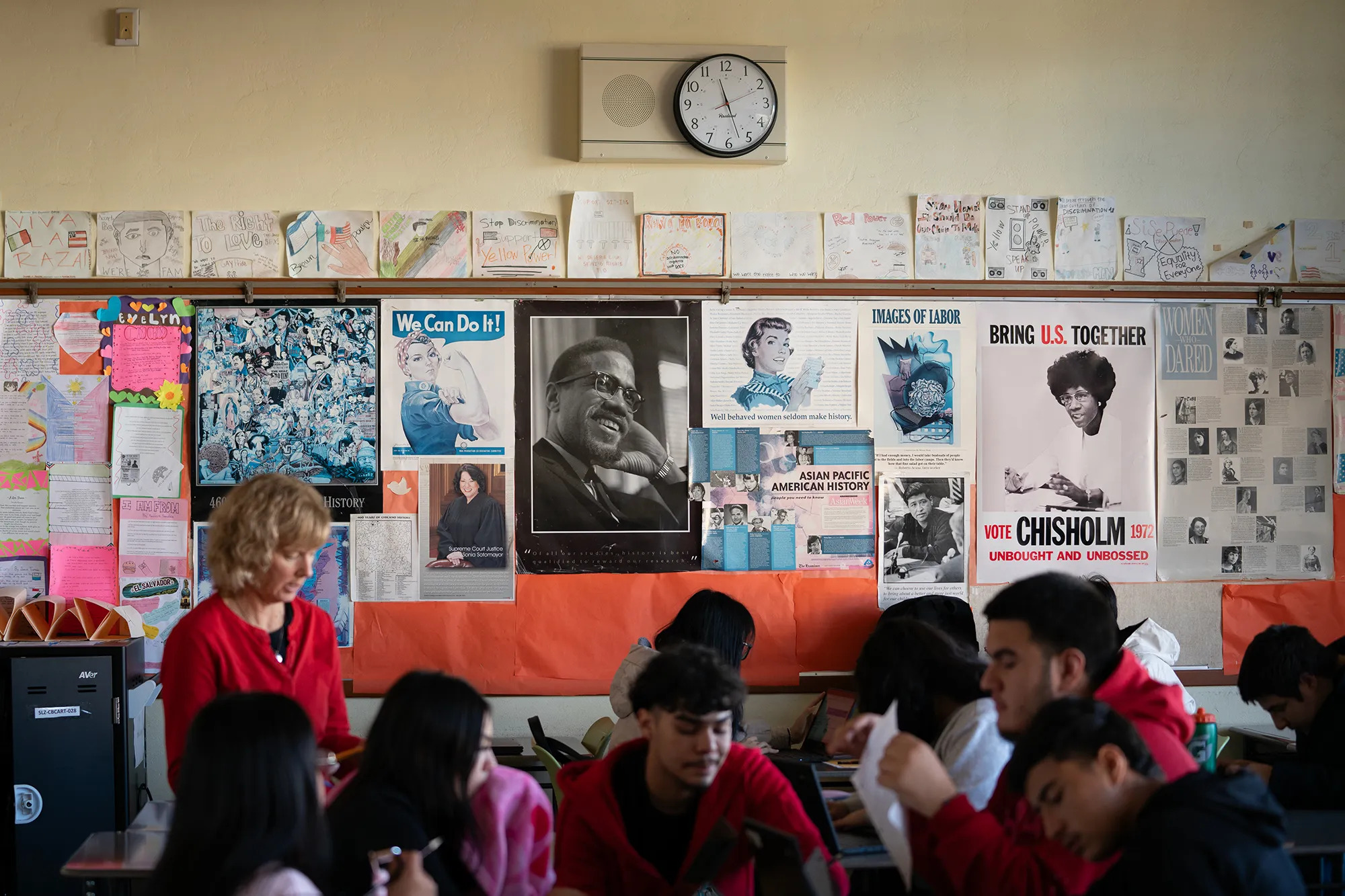
“I don’t focus too much on what Congress did this week, or what the president said. It’s too depressing, and kids feel hopeless,” Shimogawa said. “Instead, I try to make them feel like they have a voice, and give them the tools to advocate for good.”
Amber Bradley, who teaches government at River City High School in West Sacramento, said that regardless of the dueling America-at-250 curricula, it’s a stressful time to be a civics teacher.
“Being a civics teacher right now is complicated,” Bradley said. “We teach kids about their rights, but then they see the federal government ignore those rights. It’s discouraging for everyone.”
Like Shimogawa, Bradley gives her students plenty of hands-on projects that allow them to feel empowered. And she tries to keep her classroom nonpartisan, so students feel comfortable expressing their opinions and ideas — no matter what they are.
“It’s an overwhelming time for them and me,” Bradley said. “But I know my kids will make a difference. They’re going to change things for the better.”
Free speech and open inquiry
At Futures High School in Rio Linda, a charter high school north of Sacramento, students said they want civics class to be a place where they can ask questions about current events and express their opinions freely, without feeling attacked or embarrassed. They also want to learn what their rights are, how the legal system works and how they can protect them.
More than half the students at Futures are immigrants, with most coming from Russia and Ukraine. Nikita Artemov, a senior who immigrated from Russia, said that he highly values free speech and wants to hear other students’ viewpoints, not just in civics but in all classes.
“I want teachers to encourage discussion between students, promote an open environment,” said Artemov, who along with his classmates attended a civics education conference in Sacramento recently. “I want to hear students from different countries with different perspectives.”
His classmate Zinat Nabizada, an immigrant from Afghanistan, agreed.
“Just hearing someone else’s opinion is a really big thing,” she said. “If people want to ask a question or say what they think, they should be able to.”
A personal quest
Matsuda, the former Anaheim superintendent, now devotes himself full time to promoting civics education. For him, it’s a personal passion: his parents, U.S. citizens of Japanese ancestry, were interned during World War II.
He sees similar threats to civil liberties happening now in the U.S., making civics education all the more important at this point in history.
Students need to learn about real-world problems, who is responsible, and how to use democratic systems to address those problems, he said.
“The Constitution is being challenged almost every day. It’s easy to talk about democracy, but what does it mean on the ground?” Matsuda said. “We need to teach civics in a way that is non-partisan and not imposing adult opinions. If that doesn’t happen, our country will become more divisive than ever. This is absolutely vital for the next 250 years.”
This article was originally published on CalMatters and was republished under the Creative Commons Attribution-NonCommercial-NoDerivatives license.