
Jojo Galvan Mora, CHM Digital Humanities Fellow, writes a brief history of Cuban independence, the country’s ties to the United States, and Cuban relations with Chicago.
On the island of Cuba, May 20 is a day just like any other. However, for the roughly 18,000 Cubans who call Chicago home, and for the thousands more in the diaspora around the world, May 20, 1902, is remembered as one of the most important moments in the island’s history. On this day, the Cuban flag, the Estrella Solitaria (Lone Star), was raised for the first time over the Castle of the Three Kings of Morro in the bay of Havana, marking the end of formal US military occupation, thereby inaugurating the Republic of Cuba as an independent nation, kickstarting over a century of complex international relations between both countries.
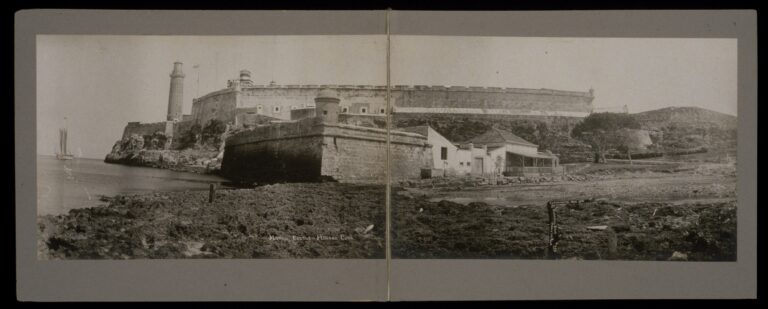
View of the Castillo de los Tres Reyes del Morro (Castle of the Three Kings of Morro), Havana, Cuba, c. 1899. Library of Congress, LC-USZC2-6452
The flag raising on May 20 was the culmination of nearly a century of intertwined history between the island nation and the United States. What first began as an amicable trade relationship between the US and the Spanish territory in the early 1800s quickly became so important and profitable that, in 1848, US president James K. Polk formally offered the Spanish empire $100 million to purchase the island, an offer that Spain declined. Despite the denial, trade between the US and the island continued, with the US becoming the largest buyer of Cuban sugar by the 1860s. In 1868, the island entered into militarized conflict seeking independence from Spain in what would come to be known as the Ten Years’ War. During this time of crisis, the US became a place of sanctuary for those fleeing the violence, as the country welcomed more than 10,000 Cubans immigrants throughout the duration of the fighting. Two more conflicts would follow in pursuit of independence from Spanish rule, the first in 1879, and and the second in 1895.
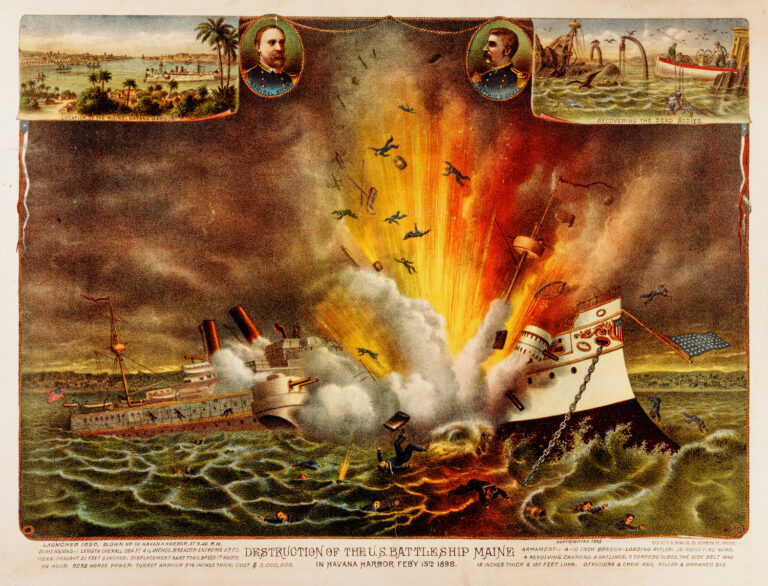
Lithograph depicting the destruction of the USS Maine in Havana Harbor during the Spanish-American War, Havana, Cuba, February 15, 1898. CHM, ICHi-008428. The destruction of the Maine has long been the subject of historical debate, with press reports blaming the incident on Spanish forces, while other records point to an accidental explosion.
The third struggle for independence would finally see the United States entering the conflict after the USS Maine exploded in Havana Harbor in February 1898, with the international press quickly placing the blame on Spanish forces, and the US government formally declaring war in April. The Spanish-American War lasted a little over three months, ending in August with Spanish defeat. As part of their concessions, the Spanish empire ceded control of the Philippines, Guam, and Puerto Rico to the US, and a military protectorate, the Platt Amendment (proposed 1901, approved 1903), over the island of Cuba.
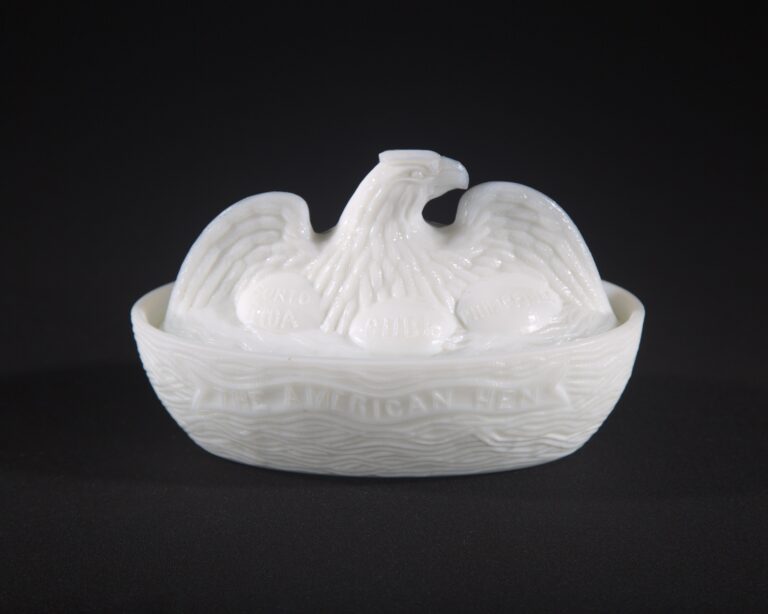
Milk glass dish with lid titled The American Hen, in the shape of an eagle sitting on a nest of eggs labeled ”Porto Rica” (Puerto Rico), Cuba, and Philippines, 1898. CHM, ICHi-179104
The Platt Amendment placed Cuba under US military and financial guardianship until the island’s political leaders, many of whom were installed by the US government, could draft and ratify a new constitution. In 1901, the assembly tasked with drafting a new constitution for Cuba rejected the terms of the Platt Amendment, a demand which then-US president Theodore Roosevelt rejected. In June 1901, a new constitution was approved, with the Platt Amendment included as an official appendix to the new nation’s founding document. In December of that year, elections were held, and after some controversy, Tómas Estrada Palma, a naturalized US citizen residing in the mainland was elected to lead the Cuban Republic, formally ending the occupation when he took office.
The legacy of the Platt Amendment is vast. It established the terms for the lease over the area that would become the infamous Guantanamo Bay detention facility and opened the door to extensive US immigration and investment on the island. By 1902, more than 15,000 residents on the island were US citizens. On the US mainland, the topic of Cuba was one of constant debate, with many seeing the terms of the Platt Amendment as little more than a US version of European imperialism, a sentiment fueled further by growing Cuban populations in cities like Miami and New York.
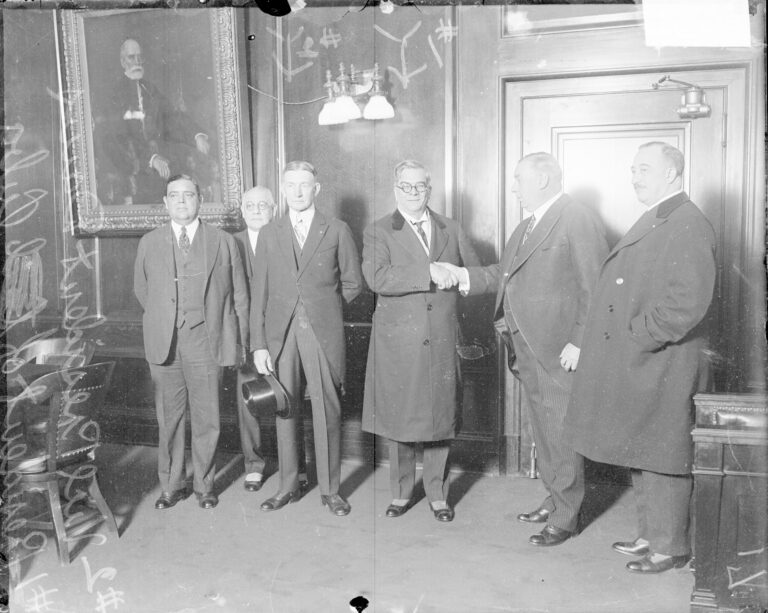
Charles G. Dawes (holding top hat), vice president of the United States from 1925 to 1929, stands next to Gerardo Machado (wearing glasses), president of Cuba, who is shaking hands with Chicago mayor William Hale Thompson, along with a group of men during a visit to Chicago, 1927. Machado is shaking hands with one of the men. DN-0083489, Chicago Sun-Times/Chicago Daily News collection, CHM
While Cuban migration to the Chicago metro area would not come until the middle of the 20th century, the Windy City served as a host to Cuban civic and political leaders. In 1927, US vice president Charles G. Dawes hosted Cuban president, and later dictator, Gerardo Machado as part of a larger effort to demonstrate goodwill and the importance of commercial and political ties between both nations. While this visit may seem little more than a trivial footnote, it demonstrates the depth behind the history tying both nations as political and economic allies, opponents, and sites of cultural exchange. In many ways, it’s impossible to adequately tell Cuba’s national history without giving a nod to the ever-present shadow of US policy, a complex reality that continues to this day as policies around trade, immigration, and national sovereignty continue to shift.