

(RNS) — The U.S. Conference of Catholic Bishops plans to vote Thursday (June 11) on revisions to its cornerstone document addressing the sexual abuse of minors, including new language that emphasizes “the presumption of innocence” for accused priests.
But a prominent archbishop pushed back during a Wednesday presentation of the proposed revisions, urging the conference to take more time to consult survivors and priests.
“ I am worried how the language presently in the draft will impact our known victims as well as our unknown victims,” said Archbishop Shawn McKnight of Kansas City, Kansas. “I’m also concerned about how our priests are going to respond.”
The Charter for the Protection of Children and Young People, commonly known as the Dallas Charter, is a set of policy commitments that the bishops created in 2002 as the church began to reckon with the full impact of the church’s sexual abuse crisis victimizing children. Since then, the document has been revised three times.
One of the flashpoints has been whether the charter should expand its scope to sexual abuse of adults in the church, too.
Richmond, Virginia, Bishop Barry Knestout, chair of the committee on the protection of children and young people, who gave a presentation on the revisions, said the committee holds the position that sexual abuse of adults is “outside of the scope of the charter.” He said the committee on clergy, consecrated life and vocations will develop a separate document “focusing on standards of professional behavior for both clergy and laity with adults.”
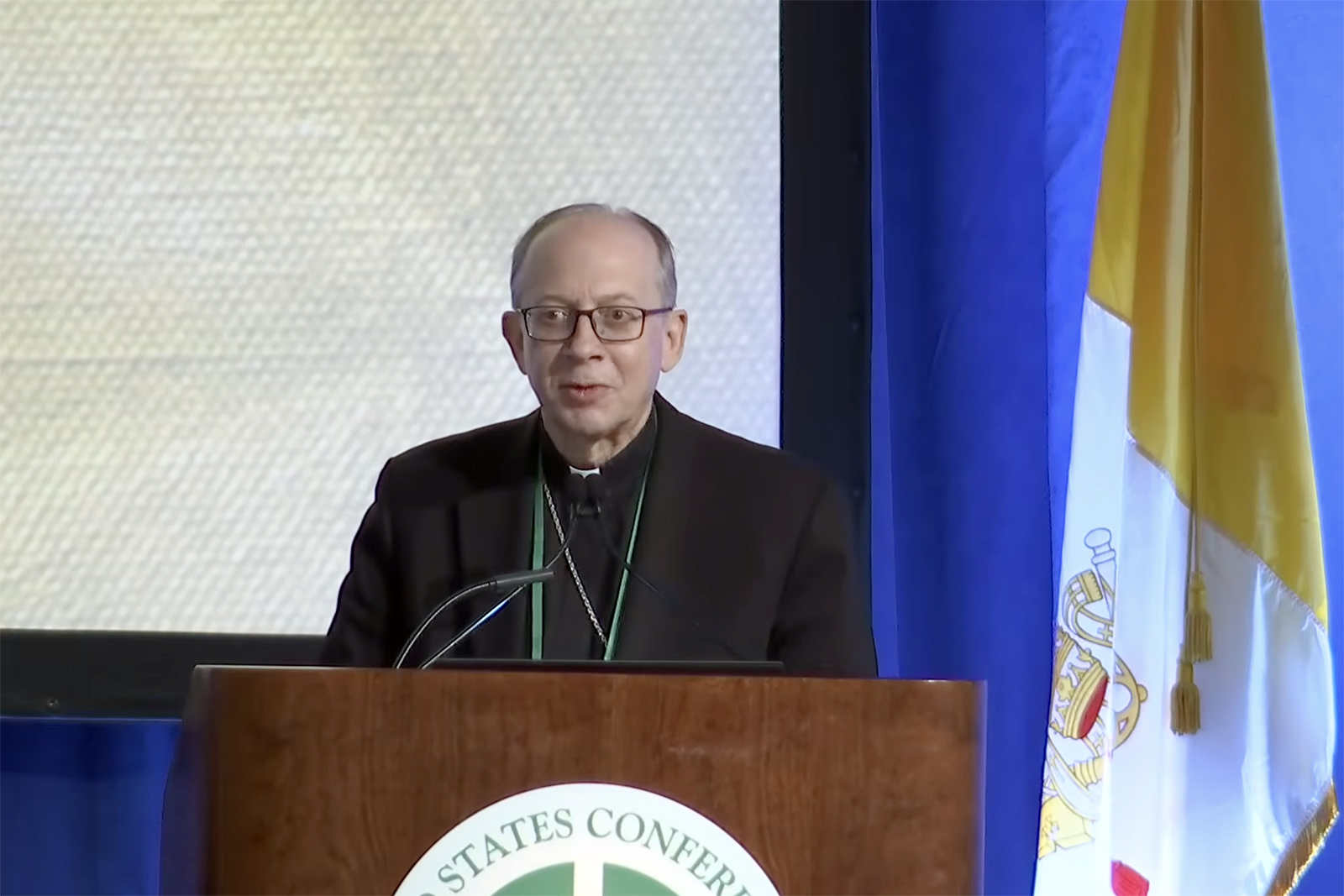
Bishop Barry Knestout speaks during the U.S. Conference of Catholic Bishops meeting, Wednesday, June 10, 2026, in Orlando, Fla. (Video screen grab)
But advocates who focus on sexual abuse and survivors told RNS that they see addressing the abuse of adults as urgent.
“Adults continue to experience devastating abuse in situations of vulnerability like confession, spiritual direction, pastoral support, religious life and employment, yet there are very few safeguards in place to protect adults from abuse in the church,” said Sara Larson, executive director of Awake, a survivor support and advocacy organization. “It is high time for the U.S. bishops to seriously commit to protections for adults. This cannot wait.”
Many adult abuse survivors have been “deeply wounded not only by the abuse itself, but also by the refusal of some church leaders and community members to acknowledge that what occurred was, in fact, abuse,” she added.
Terence McKiernan, founder of the online archive of the Catholic clergy abuse crisis, BishopAccountability.org, echoed those concerns. He said McKnight was right to point out that the last known consultation about the impending separate adult document happened in 2022, even as prominent abuse cases have surfaced since then.
McKiernan also said he thought priests might be skeptical about added language about the rights of accused priests, given that those rights are adequately protected in canon law. Most priests, McKiernan said, “want this document to be a document for survivors, not for disgruntled priests or disgruntled bishops.”
He added that many priests who feel their bishops “hung them out to dry” back in 2002 won’t be convinced by the document.
BishopAccountability leaders said in a statement they believed that the bishops were “backing away from their commitment to survivors” and that “authors of these revisions seem to have slept through most of the important developments of recent years” — including what they called the ubiquitous nature of spiritual abuse, the role of religious sisters in experiencing and committing abuse, concerns about the abuse of Black and Indigenous Americans and questions about defining credible and substantiated allegations.
The Rev. Hans Zollner, a Jesuit and leading expert in Rome on combating abuse, told RNS that he didn’t think the new language related to due process in the revisions should be interpreted as bending the process in favor of clerics.
Due process “has been enshrined in the charter from the very beginning,” Zollner said. “On the side of those who would judge the cleric, they must provide processes that are fair and just. On the cleric’s part, however, there is an obligation to respond to those processes honestly and openly beyond purely legal terms.”
McKnight, the Kansas City archbishop, has had a more expansive vision for edits to the Dallas Charter and has submitted his own draft revisions to the conference, according to 2025 reporting by Catholic news site The Pillar. That document included new language about the trauma caused by abuse, guidance about sexual abuse of adults, a call for restorative justice practices and several rights of the accused priest, including the right to clear information about allegations, according to The Pillar.
Arguing for further discussion before approving changes to the charter, McKnight pointed out that many bishops in the conference have been appointed since 2022, the last time he knew of that those outside the committee were consulted on the issue. “ We haven’t seen the kind of consultation that, behind closed doors, the committees have been dealing with. That’s the difficulty I see here. It is endemic of the culture that we have as a conference,” he said.
Larson, Awake’s executive director, said that ultimately, what matters is how the instructions are implemented “in real situations at the ground level.”
“We continue to hear from survivors who have been deeply traumatized by the response they received when interacting with a diocese, so we urge all dioceses to carefully evaluate how they can implement the charter in a compassionate, trauma-sensitive way,” she said.