

On her first anniversary in office, the former East Bay representative promised Oaklanders continued stability and growth.
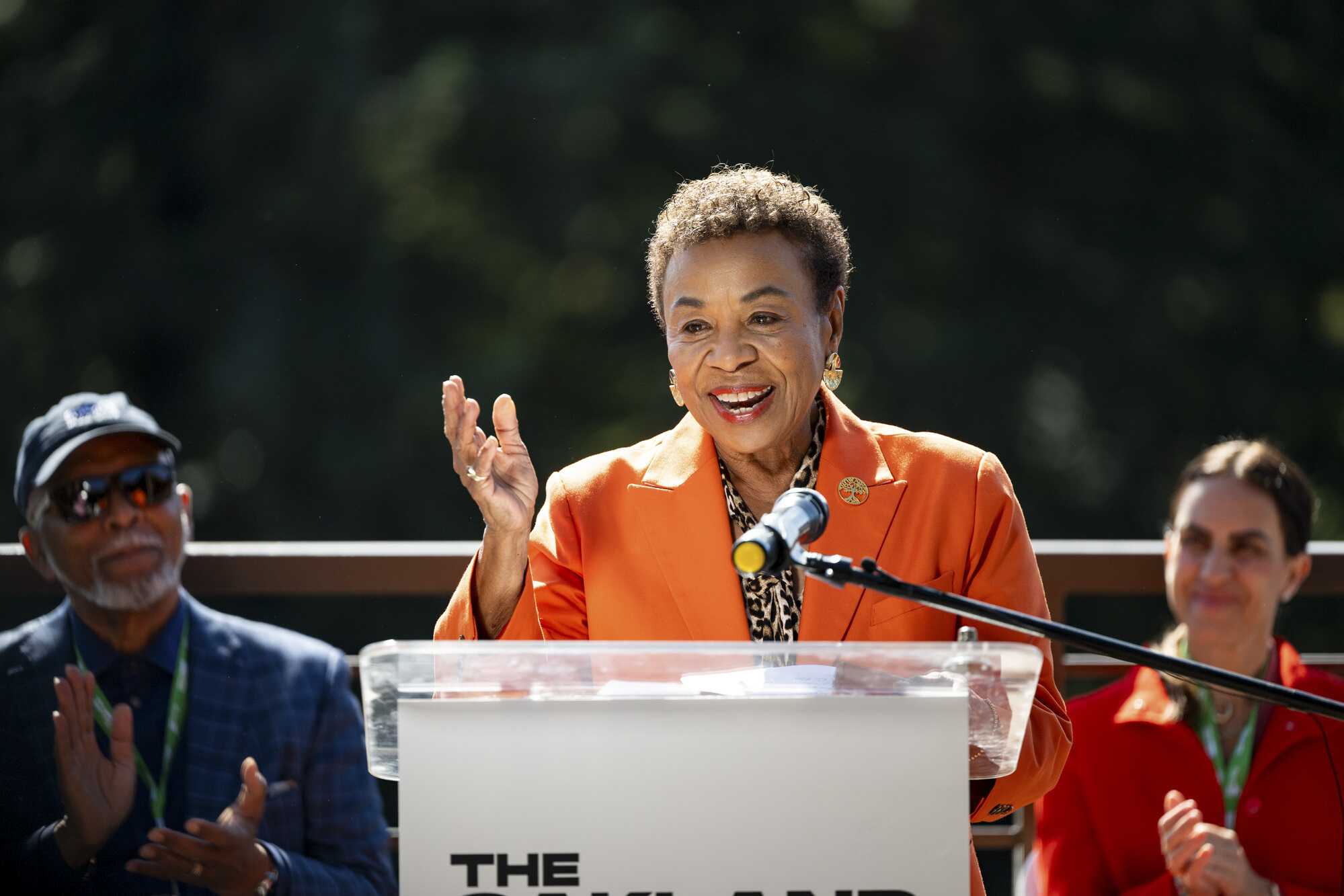
Mayor Barbara Lee speaks during a press conference announcing new affordable housing for Oakland Unified School District teachers and school employees at a recently purchased residential building in Oakland on April 2, 2026. (Beth LaBerge/KQED)
In the face of these challenges, Lee promised Oakland “stability.”
“When I looked at what was taking place in the city because of that instability and chaos and divisiveness, I thought it was the best decision to make for the good of the city to first come in and say we’re going to try to minimize the chaos and the confusion,” Lee said. “And create a path forward.”
That vision was tested last week, when public records revealed a series of inappropriate text messages City Administrator Jestin Johnson had sent about female colleagues in 2024. In one, Johnson described a female subordinate as his “kryptonite,” and wrote: “My goodness, [she] has a helluva walk.”
Lee said she was unaware of the texts until they became public and opened an investigation in response. She accepted Johnson’s resignation on Sunday and appointed Assistant City Administrator Betsy Lake as his interim replacement.
“I acted decisively,” Lee said.
The texts surfaced alongside documents subpoenaed during the FBI’s ongoing corruption investigation into Thao, who appointed Johnson as city administrator in 2023 to oversee the city’s day-to-day operations.
In other messages from 2024, Johnson texted former Assistant City Administrator Harold Duffey, saying a female department head “had me a little giddy.”
“I’m telling you, you have to sit next to her,” Johnson said. “I have to force myself to only look into her eyes.”
Lee alluded to Johnson when she said that she kept former members of Thao’s staff on when she took office a year ago because of the need for stability.
“I wanted a smooth transition,” she said.
That pursuit has guided much of the former East Bay representative’s first year in mayoral office.
She released her first budget proposal for 2026-27 on Friday, which will determine whether Oakland can maintain or increase critical services, or whether cuts are on the way. Lee has pinned many of her ambitions on Measure E, a new parcel tax on the June ballot that could add $34 million in additional revenue each year.
Lee also pointed to her success in reinstating a summer youth employment program, bringing two new banks to the city and using new AI drone technology to crack down on illegal dumping.
She has deliberately avoided public fights with the City Council, describing her approach as one of “restraint.”
“Some wonder why I don’t exercise my authority breaking ties,” she said. “Why would I break a tie to create more instability?”
Her reasoning, she said, is that Oakland needs to change how it’s perceived in order to compete for business investment — and the jobs and economic activity that come with it.

“I wanted to be able to show the rest of the country and the world and Wall Street that the chaos was going to end,” she said.
For Lee, another way to encourage stability in Oakland is to change the government’s structure. Lee and Council President Kevin Jenkins are pushing a ballot measure to turn Oakland into a “strong mayor” city.
Oakland currently operates under a hybrid form of government where power is split between the mayor, city administrator and city council. Lee said that the arrangement makes it difficult to hold anyone accountable.
“Any form of a hybrid creates confusion, chaos and is really frustrating for residents because they don’t know where the buck stops,” she said.
Under the proposal, power would be concentrated in the mayor’s office, giving the mayor veto power over City Council votes, including the budget, and more direct oversight of city departments. Council could still override a veto with a two-thirds vote. The measure would strengthen the council in other ways, making it full-time instead of part-time.

The council’s Rules and Legislation Committee is set to hear the official proposal tomorrow and will decide whether to place it before voters on the November ballot.
In the Bay Area, only San Francisco currently uses a true “strong mayor” system.
Some critics see Lee’s proposal as a power grab. But Lee rejected that characterization, instead arguing that it would make the city more efficient.
“I don’t need to be involved in a power struggle with anybody in Oakland,” Lee said. “I want this city to function, I want the services to be delivered, and I want you to know who’s accountable, whether it’s me as mayor or whoever is elected as mayor.”
Lee told the San Francisco Chronicle that she would formally announce after the June primary.
“I look forward to actually another four years as mayor,” she told KQED. “We have many challenges but many opportunities, and I’m determined that Oakland is going to be the cleanest and safest city in the country.”