

ELIZABETH, N.J. — On a Sunday in March, the Rev. Canon Andy Moore looked out at the empty back-left pews at St. Elizabeth’s Episcopal Church, which had once been filled with Haitian immigrants. “We pray in a very special way for our Haitians who aren’t here at this service, stricken by fear,” he said, before breaking the Communion wafers.
Only a few months earlier, his Haitian parishioners were reviving the aging St. Elizabeth’s, whose choir had gone dormant. Nearly a dozen Haitians led the church in worship on Christmas Eve, singing “Mèsi Bondye”—thanking God in Haitian Creole. St. Elizabeth’s had helped many of them find housing, learn English and secure jobs in the U.S.
That morning, though, Haitian parishioners had good reason to stay home: Word had spread that immigration enforcement agents were gathering outside a nearby Wendy’s — two blocks from St. Elizabeth’s.
Last November, the Trump administration announced it sought to terminate Temporary Protected Status (TPS) for Haitians, and fears of arrest among Haitian immigrants soared in New Jersey and across the country, as mass deportation efforts were underway. The Supreme Court heard oral arguments in a case challenging the revocation of TPS in April and is set to rule on the fate of some 330,000 affected Haitians by late June.
At Voice of the Gospel Tabernacle, in Boston’s Mattapan neighborhood, parishioners deliver groceries to two dozen Haitians who fear leaving their homes to come to the church’s food pantry. Three hundred people used to gather there on a Sunday. Now Bishop Nicholas Homicil, the church’s lead pastor, estimates about 80% stay home. Across the Southern Baptist Conference’s National Haitian Fellowship, with over 500 churches nationwide, there has been an average 30% decline in attendance, according to the Rev. Keny Felix, president of the fellowship and senior pastor at Bethel Evangelical Baptist Church in Miami.
Moore’s efforts to bring Haitians back to St. Elizabeth’s have proven unsuccessful. A donated minivan to shuttle Haitian immigrants to and from church required more repairs than the church could afford, and the two drivers — both Haitian immigrants — began feeling unsafe themselves. A WhatsApp group chat, called “Haitian ministry,” where a church member translated Moore’s messages offering rides from English to Creole, found few takers.
Even with Zoom, they are afraid. They say they don’t want to be tracked.
A church member who requested the pseudonym Roseline for fear of immigration enforcement
“They said no, they don’t want to come over,” said the church member, who requested the pseudonym Roseline for fear of immigration enforcement. “Even with Zoom, they are afraid. They say they don’t want to be tracked.” Then she corrected herself. “We are afraid, not ‘they.’ We are afraid.”
Haitians were first granted TPS in 2010 after an earthquake killed over 220,000 people and displaced 1.5 million. Protections have been repeatedly extended as Haiti has experienced a succession of crises.
The fear spreading through Haitian communities in the U.S. now is inseparable from what drove them to flee Haiti in the first place.
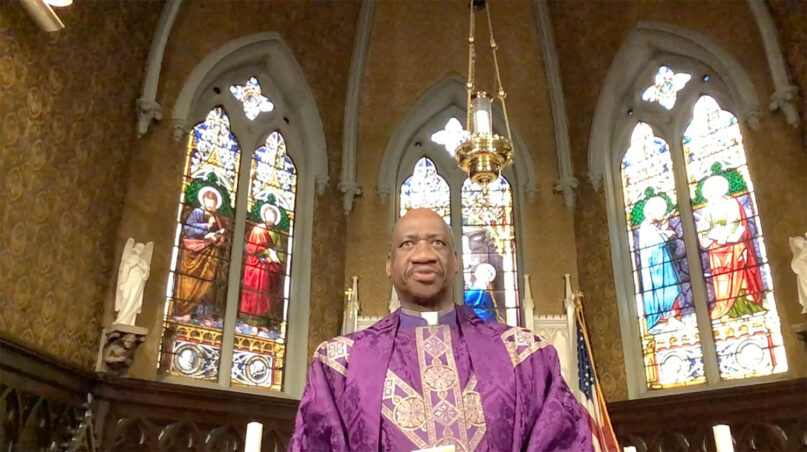
Rev. Canon Andy Moore introduces himself and St. Elizabeth’s Episcopal Church. Video Screengrab
One St. Elizabeth’s parishioner told RNS that she held leadership roles at her Pentecostal church in Cité Soleil, one of Port-au-Prince’s most violent neighborhoods. Then gang violence destroyed her husband’s trucking business, and a shootout burned down her childhood home in May 2023. A few months later, she and her husband, with their 1-year-old in tow, crossed Nicaragua, Honduras, Guatemala and Mexico, landing in Texas before making their way to New Jersey.
They found St. Elizabeth’s in April 2024, through an English class St. Elizabeth’s offered. Moore quickly realized they were “practically homeless.” The church put them up in a hotel until they secured housing and connected them with legal aid to apply for TPS. They found ways to give back: She sang solos with the Haitian Creole choir; her husband became one of the volunteer drivers. Before the influx of Haitian refugees began arriving in Elizabeth in 2010, Moore said, church membership was largely flat, in the low forties on a Sunday. (Together, the Haitians and new parishioners who joined the church to support them quadrupled this number, he said.)
Moore said he saw “an opportunity,” and the church started collecting non-perishable foods and clothing for new arrivals. Soon came the English classes, which outgrew a small room above the sanctuary to attract more than 300 eager Haitian students.
Church members helped newcomers secure stable jobs, often as home health aides or nursing assistants — fields where New Jersey faces an acute shortage. Sam Crawford, St. Elizabeth’s organist, created résumés for over 100 recent migrants. Crawford spent so much time printing copies at the Elizabeth Public Library that a staffer called Moore, inviting St. Elizabeth’s Haitian students to the library’s own English classes. But they preferred staying at church.
“They became very familiar with our teacher here and this environment, and it was not as public as the library,” Crawford said. “They stuck to us more.”
Rev. Canon Andy Moore of St. Elizabeth’s Episcopal Church. Photo courtesy St. Elizabeth’s Episcopal Church
The Haitians soon became fully ingrained in the life of the church, serving as acolytes and Eucharistic ministers. On Sundays, Scripture was read in French and Haitian Creole.
“After worship, you’ll have to push them out the door, because they’ll be here for hours,” Moore said. They cooked the pork shoulder delicacy known as griot in the church kitchen, and conversation would spill into song.
At 10 p.m. on Jan. 1, Moore invited dozens of Haitians and other Caribbeans to St. Elizabeth’s parish hall to celebrate Haitian Independence Day over soup joumou, “freedom soup,” which he’d learned to prepare. Those who came stayed until two in the morning. “It’s like they told us, ‘We know you are here, and we see you, and you matter,’” Roseline said. “That’s why Jesus is sharing food all the time.”
Yet she was one of the few who still felt safe. The woman from Cité Soleil stopped singing in the Haitian choir before Christmas, when her husband became too fearful of being detained to keep driving fellow Haitians to church. A week after the fête, even Roseline stayed home for more than two months. When she cautiously returned, she was nearly always the only Haitian in the pews.
“I think it was the biggest blow to my whole ministry,” Moore said. “I’ve dealt with all kinds of setbacks, challenges, but this one really, really shook my faith.”
I’ve dealt with all kinds of setbacks, challenges, but this one really, really shook my faith.
Rev. Canon Andy Moore
The thought of shuttering St. Elizabeth’s doors is never far from mind for Moore. On Good Friday, Moore looked over a mere 18 worshippers, including those behind the organ and altar.
St. Agnes’ Episcopal Church in nearby Little Falls, New Jersey, he announced, would have its last service on Easter Sunday after 130 years due to a diminishing congregation.
“They die, yet we live,” Moore said, praying as much as declaring. “Please, as testimony of the life that Christ is bringing to us, bring a friend, bring a family member.” Then his thoughts turned to the Haitians behind locked doors, not unlike the disciples that first Easter. The church they led in song just months ago is now left hoping for another resurrection.
“Let this church be filled with voices, especially for those who are missed,” Moore said. “We sing for those who cannot sing.”
Noah LaBelle is a journalist and student at Princeton University. He has previously contributed to The Guardian, among other publications.