

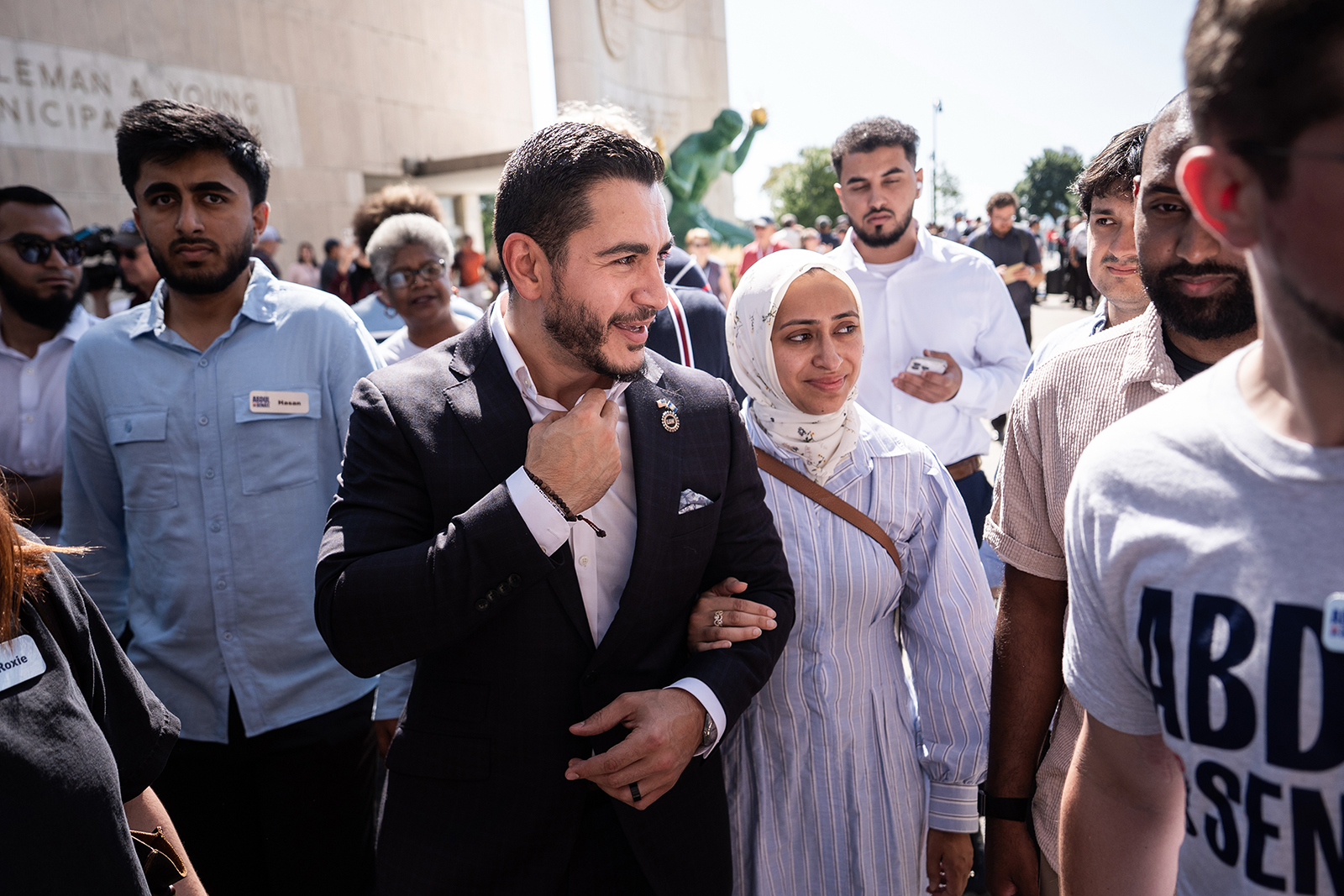
(RNS) — Within 24 hours of Abdul El-Sayed becoming Michigan’s Senate Democratic nominee, the candidate faced an onslaught of attacks. But instead of critiquing his policy positions or campaign promises, the comments focused on his background and Muslim faith, framing the epidemiologist-turned-political candidate as a danger to the country.
Sitting in the Oval Office, President Donald Trump referred to him as a “jihadist.” The National Republican Senatorial Committee published a digital advertisement referring to El-Sayed by his full name and labeling him a “radical.” And Rep. Nancy Mace of South Carolina, who once championed the separation of church and state, published a post on X insisting every “Muslim holding public office in America is a Trojan horse and a threat to both national security and our republic.”
El-Sayed has deflected the attacks, saying the GOP is resorting to Islamophobia “because their ideas are tired.”
“I’ve been Abdul in Michigan my whole life,” he told MS Now. “I’m so grateful for the way Michiganders have embraced me and my family, and I know that Michiganders are open-minded, they’re big-hearted, they’re less interested in how you pray than what you pray for, and we all pray for the same thing.”
But the wave of vitriol directed at El-Sayed added to a rise in blatant anti-Muslim sentiment in mainstream politics that experts say is unprecedented, with politicians openly condemning the faith in new ways. Analysts say that unlike past spikes, which tended to focus on tying Islam to violence, the version of anti-Muslim bigotry that has emerged this year also reflects xenophobic talking points from far-right factions in Europe, who cast the world’s second-largest religious tradition as an existential threat to the Western world.
RELATED: Abdul El-Sayed could be the first Muslim senator. Here are 5 religion takeaways from his campaign.
Anti-Muslim hate targeting El-Sayed online rose twentyfold in the days after his win, according to a study from the Washington, D.C.-based Center for the Study of Organized Hate. Many tied El-Sayed to terrorism, but the study noted others claimed he would impose Islamic law and warned of the alliance between “Islamists and communists.”
Posts also “advocated ‘remigration,’ the mass removal of Muslims from Western countries, as the only solution to a claimed ‘Islamic takeover,’ ‘invasion,’ and ‘conquest,’” according to the study.
For Mobashra Tazamal, associate director of The Bridge Initiative, the comments speak to a shift toward a form of anti-Muslim rhetoric that frames Muslims in the U.S. not just as a “security threat” but also as “a cultural threat.”
Purveyors of such rhetoric, she said, are “creating a manufactured narrative and hysteria around a so-called Sharia takeover, trying to create this narrative that Muslims are going to take over the U.S., which is completely false.”
“It’s scary: Is there a line for the GOP when it comes to Islamophobia? I don’t think there is,” added Tazamal.
Several experts who spoke to RNS also noted the tendency to frame Islam and Muslim immigration as a threat to “Western” values. It’s an argument that has already gained traction in far-right European circles: At last year’s National Conservatism conference in Washington, speakers repeatedly referenced Muslim immigrants in Europe, with Center for Renewing America senior fellow Nathan Pinkoski warning that the continent’s “trashed civilizational immune system” allowed “Islamists to make inroads into European nations.”
Critics of Pinkoski and others have long rejected the idea that Muslim immigrants are fundamentally altering Europe. In addition, many note that Europe-focused Islamic immigration narratives don’t apply to the U.S., where Muslims represent roughly 1% of the population and where Trump has banned entry from several Muslim-majority countries and frozen the refugee program for all but primarily white Afrikaners from South Africa.
Even so, some Republican officials have welcomed far-right, anti-Islam European leaders in the past year, saying Europe is a cautionary tale. In Texas, Republican Congressmen Chip Roy and Keith Self hosted British agitator Tommy Robinson at an April event titled “Confronting the Islamization of Texas and our Nation.” Dutch politician Geert Wilders also headlined a conservative conference alongside former White House official Steve Bannon in January.
In the U.S., this shift may be a response to an emerging political paradox: Despite multiple spikes in intense rhetoric directed at Muslim Americans over the past few decades, New York Mayor Zohran Mamdani and other American Muslims have nonetheless won elections in various parts of the country. According to a new report from the Council on American Islamic Relations and CAIR-Action, 228 American Muslims from 26 states serve at local, state and federal levels.
Meanwhile, Islamophobic attacks have become an expected part of the campaign trail for Muslim candidates. Worse, the rhetoric extends beyond the candidate and is “incredibly dangerous” for average Muslims in the country, said Nazita Lajevardi, an associate professor of political science at the University of Michigan.

“Even if you don’t come out and explicitly say, ‘I’m speaking about all Muslims,’ you’re certainly putting the associations in people’s minds,” Lajevardi said. “And you’re heightening a sense of security threat, an existential threat, that the American public already feels about American Muslims.”
Lajevardi said some people are emulating anti-Muslim narratives from top elected officials, including from members of the Sharia-Free America Caucus. The group, which boasts 68 Congress members, targets what it claims is a growing threat of Sharia, or Islamic religious law, in the U.S., a move that harkens back to anti-Islam movements that flourished during the post-9/11 era and the early 2010s. Caucus members have introduced seven related bills, though they have gained little traction in the House. One of the bills, No Sharia Act, seeks to restrict American courts from enforcing judgements based on Islamic law.
Many of the caucus members, who come from a range of faith backgrounds, have used religious language to frame their fight against the alleged threat of Sharia.
“Sharia is a direct threat to our Constitution and Western values and seeks to replace our legal system and erode our basic freedoms. Our immigration system must be prepared to confront this challenge and defend our Judeo-Christian values,” Roy, a co-founder of the caucus, said in a June press release.
Tennessee Rep. Andy Ogles, a Protestant Christian and a prominent member of the caucus, has also courted controversy for posting AI-generated videos of himself dressed up to resemble a Crusader and declaring on social media that “Muslims don’t belong in American society.” Rep. Andy Fine, who is Jewish, has fielded calls for his resignation after publishing anti-Muslim posts directed at Muslim elected officials, including Mamdani, and Muslims in general. One such post read: “We need more Islamophobia, not less. Fear of Islam is rational.”
RELATED: Congressional Democrats call GOP anti-Sharia caucus ‘hateful’
More than 100 Democratic Congress members in June condemned the Sharia-Free America Caucus as “hateful,” and comments from caucus members have triggered some religious pushback. In March, a diverse array of faith leaders — including Rabbi David Saperstein, the former U.S. ambassador-at-large for international religious freedom — attempted to meet with Rep. Ogles as well as House Speaker Mike Johnson on Capitol Hill to express outrage over anti-Muslim rhetoric voiced by Republicans. The faith leaders — some of whom called on Ogles in particular to “repent” — were unable to meet with the lawmakers, but prayed for both in their offices.
But Lajevardi, who studies how minority groups experience discrimination, said there is less pushback to the rhetoric than in past years, including among faith leaders.
RNS reached out to churches, dioceses and other religious institutions associated with around a third of the caucus members, but none of the leaders of those institutions said they had discussed the topic with the lawmakers. Most did not respond or declined to comment, although Florida Bishop Erik T. Pohlmeier, who oversees the Diocese of St. Augustine, which overlaps with the district represented by caucus member Rep. John Rutherford, noted generally that the “Catholic Church consistently upholds the dignity of every human person, supports religious freedom and advocates for immigration policies that are both just and humane.”
If Republicans see anti-Muslim rhetoric as a campaign strategy, their theory will face a major test in November. While Trump won his 2016 election campaigning on policies like a blanket ban on all Muslim immigration, other Republicans haven’t seen the same boost at the ballot box: Ogles lost his primary earlier this month, and Roy, who ran for Lt. Governor in Texas, fell short as well.
And Tazamal argued that if some are hoping to discourage Muslim Americans from running for office, those efforts are backfiring.
“It’s not scaring them to step away,” Tazamal said, referring to Muslim Americans. “It’s only making them feel that they actually do need to do more to protect themselves, and also other marginalized communities. To say to wider society, ‘Look, I belong. I am part of this country.’”